
For the 4th year in a row, DISHA team was on the ground in Geneva in July to participate in the AI for Good Summit 2026 and World Summit on the Information Society (WSIS) Forum 2026. We announced new products and new partners, hosted deep dives and demoed our solutions live. Below are the highlights from our week in Geneva.
1. DISHA partner panel discussion at AI for Good Summit announces UNHCR joining the DISHA coalition to validate and scale DISHA’s new Refugee Settlement Mapping solution
Detailed spatial data on refugee settlements, including the location and count of individual shelters, is essential for site planning, service delivery, and humanitarian response. Manually producing detailed maps of refugee settlements is extremely labor-intensive: the most recent effort to map 40 major UNHCR-supported settlements took place 4 years ago and required a team of 4-6 analysts 14 months to complete.
In “Scaling up AI in service of humanitarian crisis response and recovery,” a DISHA-hosted UN AI Hub session at the AI for Good Summit, we announced that UNHCR, the UN Refugee Agency, is joining the DISHA partnership to validate and deploy at scale DISHA’s newest solution, Refugee Settlement Mapping, powered by Google Earth AI’s Open Buildings model. The solution allows mapping settlements in minutes instead of months, for the first time enabling settlement maps to be kept up to date on an ongoing basis.
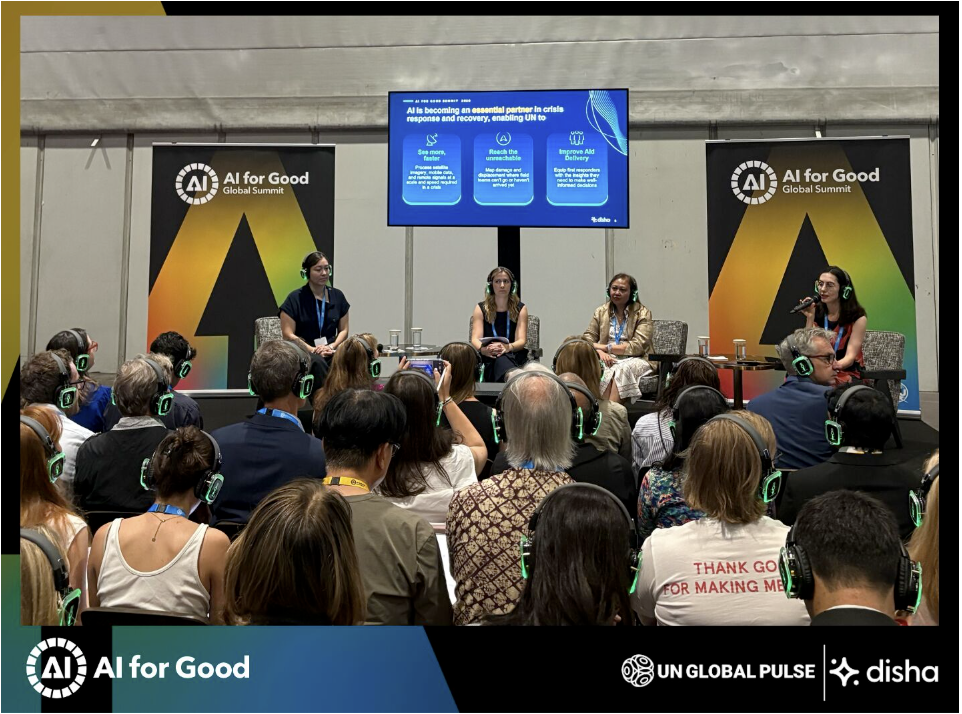
DISHA partners panel discussion at the AI for Good Summit 2026
The session featured a discussion with a few DISHA’s partners: UNHCR’s Grace Sanico Steffan, Google’s Stephanie Rees and McKinsey’s Kristina Wienhöfer, moderated by Katya Klinova, the head of DISHA. The partners discussed the collaboration model powering the delivery and at-scale use of DISHA solutions and the unique contributions each of them is bringing to the partnership. Grace explained that the real value of satellite imagery analysis speed lies in faster, better insights, helping deliver better protection for people forced to flee. Stephanie shared the origin story of Google Earth AI’s Open Buildings model powering DISHA’s satellite imagery solutions and offered a pathway for making public-private collaborations putting AI in service of humanitarian needs more common. Kristina spoke about the learnings from McKinsey’s Noble Intelligence initiative on what helps AI solutions graduate from pilots to regularly used transformative services, highlighting the role that true co-creation and organizational change management play in driving adoption.
2. DISHA booth features live product demos and hosts discussions with prospective users to identify shared humanitarians needs AI could help with
Ridho Eko Prasojo, DISHA’s Technology Lead, and Andro Kortis, DISHA’s Product Lead, welcomed the AI for Good Summit attendees and DISHA partners to the DISHA booth for live product demos and conversations about shared humanitarian needs to be prioritized for future DISHA solutions. We received great interest from humanitarian organizations and UN resident coordinators in DISHA solutions and are currently working on processing product access requests wave spurred by the Summit. We were also inspired by all the ideas of new AI-enabled products and features that we heard at the booth and have already begun feasibility studies on those.
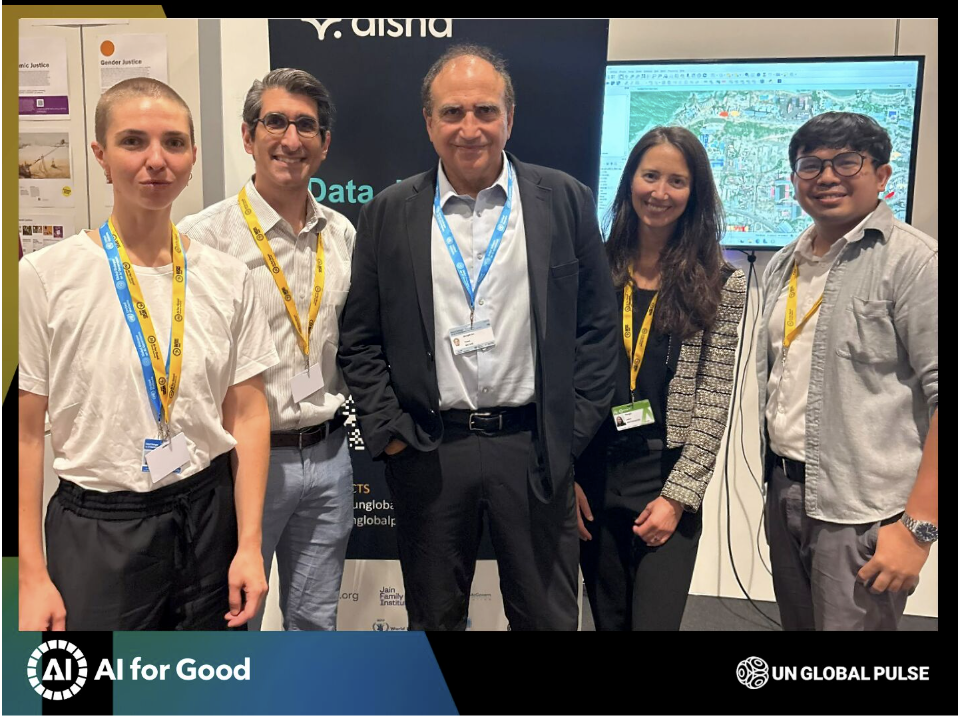
Yossi Matias, VP & GM Google Research and Google Crisis Resilience Lead and Juliet Rothenberg, Google Product Director, Climate, Earth & Crisis Resilience AI together with UN Global Pulse’s Talea von Lupin, Andro Kortis and Radityo Eko Prasojo at the DISHA booth
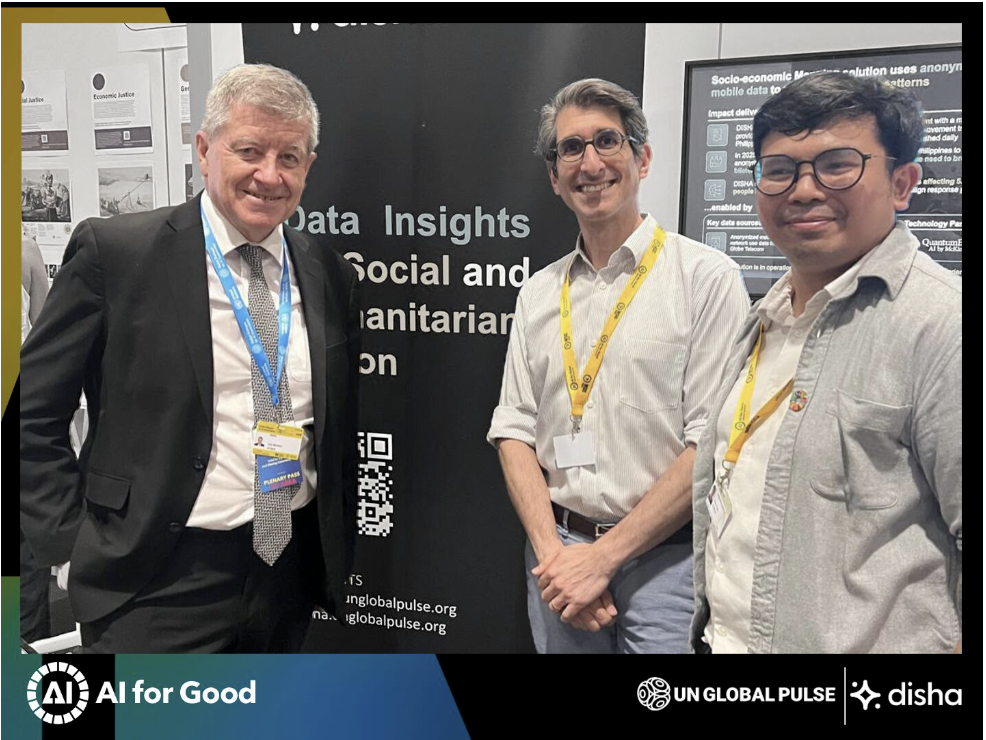
Guy Ryder, UN Under-Secretary-General for Policy (left) visits the DISHA booth
3. DISHA hosts a joint session with Google Research at the WSIS Forum to offer a deeper look at the AI models powering humanitarian solutions
Krishna Sapkota, Senior Software Engineer and Tech Lead at Google Research joined Talea von Lupin, UN Global Pulse Portfolio Manager, and Ridho Eko Prasojo, DISHA’s Technology Lead, on stage at the World Summit on the Information Society (WSIS) Forum 2026.
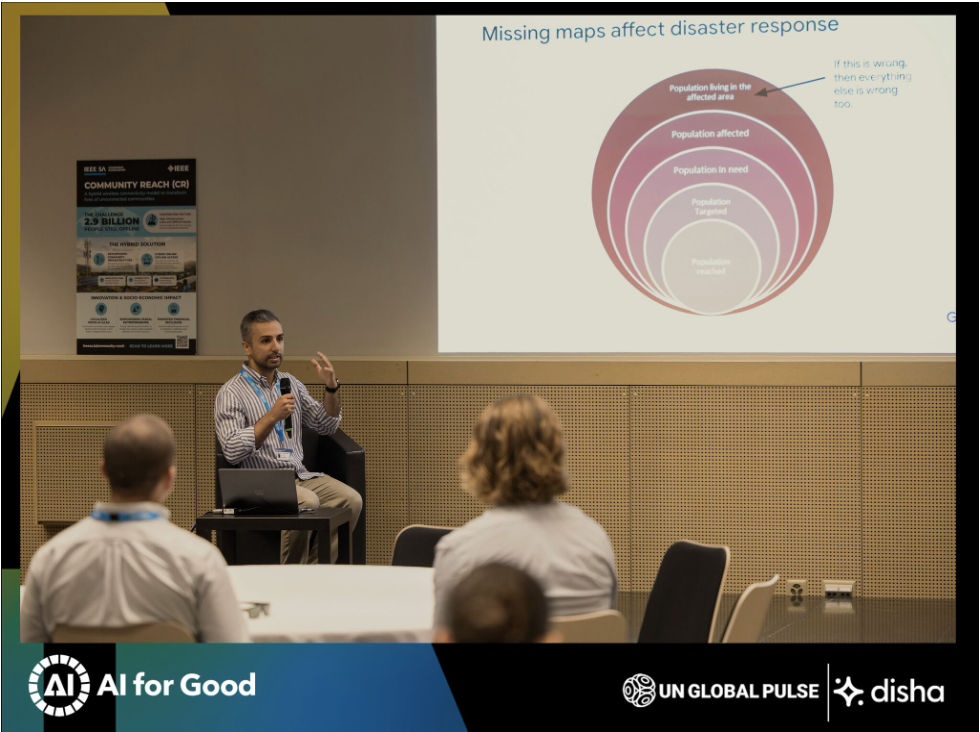
Google’s Krishna Sapkota presents at WSIS Forum 2026
Talea walked the audience through DISHA’s unique collaborative AI development model which helps secure relevant AI models and datasets to be leveraged by the whole humanitarian system. The model eliminates the need for bi-lateral agreements between humanitarian organizations and model/dataset providers thanks to DISHA acting as a central node bearing technical, partnership coordination, and legal loads. Ridho gave an overview of DISHA’s flagship solutions, now equipped with easy-to-use graphical UIs and open for all humanitarian organizations to use in their work. The solutions include AI-assisted Damage Assessment (powered by multiple Google Earth AI’s models), AI-assisted Refugee Settlement Mapping (powered by Google Earth AI’s Open Buildings model), and Socio-economic Mapping (powered by Globe Telecom’s aggregated dataset refreshed daily). Finally, Krishna provided a deep dive into the workings of the Google Earth AI’s models powering humanitarian applications, and previewed future AI research directions opening up valuable novel capabilities for crisis response.
The full talk is available at https://www.youtube.com/watch?v=TOkFYLB490g
To learn more about and request access to DISHA solutions, please visit https://disha.unglobalpulse.org/our-products/.
 Paul Beaumont,

 Jerome Hodges, Chief Research Officer, Jain Family Institute
 Arden Ali, Project Lead: Digital Ethics and Governance, Jain Family Institute
 Kersten Jauer, Deputy Director, UN Secretary-General’s Office
 Gayan Peiris,
  Ankit Bisht, Partner, McKinsey & Company
 Brigitte Hoyer Gosselink,
  Vilas Dhar,